Showing posts with label economy. Show all posts

Friday, April 06, 2012

Winter is coming

I'm not the most economically literate person in the world, but even I understand that government services aren't free. Apparently though the Greeks did.

Greece, like other countries in Europe, had given up its own currency in exchange for the euro, so it did not have the option of printing more money or devaluing the currency to pull itself out of the mess created in part by politicians who gave voters what they wanted without troubling to bring up the unpleasant fact that someone, sooner or later, would have to pay. 
Today, the Greek people are enduring economic pain that makes America look like a paradise of prosperity. Unemployment stands at 21%, wages are collapsing for both government and private sector workers. 
A series of new taxes have been imposed, including a "solidarity" tax, new property taxes and higher self-employment taxes. The VAT, a national sales tax on all transactions, has jumped from 13% to 23%. The minimum wage has been been sharply cut. Poverty has increased dramatically. 
After all that, Greece is still required by European rules to cut another 4.7% of gross domestic product from its budget, equivalent to the United States suddenly cutting more than $700 billion. 
Even if it achieves those goals, or rather because it will enact such draconian cuts, the Greek economy is expected to sink deeper.

I think what gets lost in such discussions is the historical reality that made the societies we live in possible. After WW2, much of continental Europe and Japan were devastated. Canada and more so the US, became rich as a result of coming out of the war with our industry and infrastructure intact. We were able to make astronomical amounts of money by being the suppliers for the reconstruction of Europe and other parts of the world. 

This vast wealth provided these nations with the resources to move forward in terms of societal and social infrastructure begun in the New Deal by Roosevelt. The problem is that the New Deal was economically untenable in normal times but because of war and the massive economic boom that followed the economic realities were blurred. 

So we had a whole generation, the largest in the history of North America, grow up with false economic ideologies and believing that government can and should provide for everyone. A noble aim to be sure, but then the rest of the world caught up by the 70s and the traditional sources of NA wealth began to fail and so you see the decline in manufacturing and the rise of the service and banking sectors over the course of the 80s and 90s. 

People were struggling to maintain the wealth that created the society they wanted, at relatively little cost to the average citizen and were doing anything they could to see it done. Now even these sectors have begun to fail but generations of people have been raised with the notion that this is how a society should function (not saying that its not) but they came to this conclusion in the midst of vast economic prosperity that made such a society possible. 

As the economic reality changes so too will the ability for these societies to continue to meet the demands of the people. An unfortunate thing is that the ruling political class has created a system in which they promise the moon, provide a sandwich and are rewarded for it because they've ensured that money is the prime component of political power. 

As such people having been raised to think that the government should provide will be faced with the reality that it can't. This disillusionment will lead to frustration and anger that will tax the system of control that the political elite have created over the past few decades to protect themselves from what they knew was coming. 

Hence you see the empowering of state controlled systems of control such as police and surveillance and the reduction of civil liberties and the abandonment of principles that once defined a nation but are now no longer politically tenable. This of course will lead to further civil unrest and can be seen in current movements such as Occupy and the recent warning from Anonymous to world leaders. A cycle has begun that, while in its early stages and possible to curtail, is one that pits the powerful against the powerless and as the economic realities continue to decline the pressure will increase. 

Tuesday, November 22, 2011

Bankster Obama

President Obama ran on program of change underscored by the slogan, YES WE CAN.

In retrospect it seems foolish that ordinary people believed that he was speaking to them.

In order to get elected Obama raised $750 million and spent approximately $735 million of it during the campaign. Given the astronomically high amount of money it took to achieve victory and his subsequent actions in protecting Wall Street from rightful prosecution it should come as no surprise that three of the top ten single contributors to the Obama campaign were Goldman Sachs, Citigroup and JP Morgan Chase.

And so we see this:


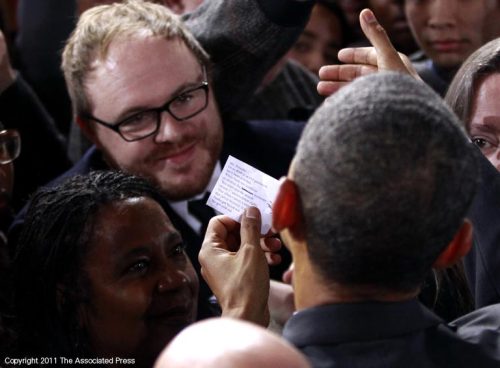
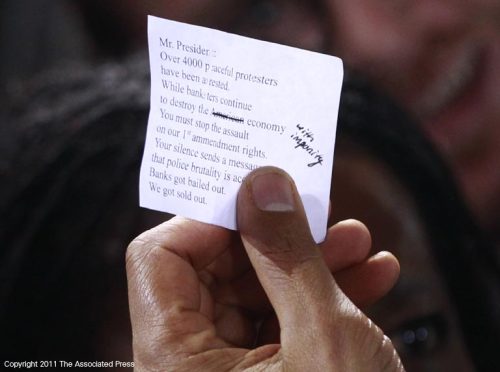
A protester handed President Barack Obama a note while shaking hands along a rope line in New Hampshire today. AP photographer Charlie Dharapak smartly zoomed in so you can read the note for yourself.
People aren't stupid. They can understand what is happening. They see a real unemployment rate of nearly 25%, a further economic contraction on the horizon, banks being protected by the government, investment firms stealing from their investors and being protected. They watch as people protesting these things are beaten and arrested while the people that imploded the economy are given bonuses and protection. They watch as the Obama administration tries to pressure state Attorney Generals to keep from prosecuting those responsible. 

When Obama was saying YES WE CAN, people thought he was talking to them. He wasn't, he was talking to the banks and corporations that funded his presidency. YES WE CAN steal from the people. YES WE CAN get away with it. YES WE CAN oppress the masses. YES WE CAN!

Wednesday, November 16, 2011

Technocrat - autocrat what's in a word?

In a move designed to bolster 'confidence' the new premier of Italy, Mario Monti, has named his cabinet which is completely devoid of publicly elected officials, or as he likes to say, politicians.
Mr Monti took on the economy and finance portfolio himself. 
Corrado Passera, CEO of the Intesa Sanpaolo banking group, was named to head the new ministry of development, infrastructure and transport. 
Another key appointment was that of Antonio Catricala, head of the anti-trust authority, who was made under-secretary to the prime minister's office. 
Despite reports that Mr Monti had sought to include politicians in his cabinet, there are none.
So nobody that the people of Italy had elected to represent them in government is part of ruling authority that will lead said government. Instead they get a group of people who are tied to banks, including Mr. Monti himself who has ties with Goldman Sachs (as do the appointees to lead Greece and the European Central Bank). All this was done to restore confidence in the markets, not the people, but the bankers who have raped and pillaged the people for the past decade and more.

I can't help but draw some parallels with China of the early 1990s. After the massacre in Tienanmen Square on June 4, 1989, China's ruling elite were split between continuing economic reform which had helped to bring about the economic disparities that had helped to fuel the movement leading to Tienanmen and a conservative return to more traditional Marxist and Maoist economic and foreign policy. Deng Xio Ping, supreme leader of China at the time wagered that people would basically keep their mouth shut concerning politics and the Communist Party so long as they brought them a better standard of living. It would seem that he was correct. Economic reform continued throughout the nineties and the Communist Party was able to secure its power base, something that was very precarious in the few months following June 1989.

Its not surprising to see the Socialist leaning European Union basically make the same wager, that they can violate the democratic principles that they claim to stand by just so long as the economy improves. I guess its just ironic that it is happening in the birth place of democracy, Athens, as well as that great killer of Republican style government, Rome.

Wednesday, October 26, 2011

That's a big number

So according to the UN the world's seven billionth resident is due to be born on October 31st. Statistics show that the world's population grows at a rate of 200,000 a day. There is talk that the earth's population could grow to be ten billion by the end of the century or even as high as 16 billion, with much of the growth taking place in poor countries.

 In 2011, the population of Ethiopia is approximately 80 million. In the next 50 years the country could see its population grow to 145 million.

 In contrast is Germany, with a 2011 population of approximately 80 million but rather than grow over the next 40 years, Germany could see its population decline to 75 million people over the next 40 years.

 There is a scenario from the UN in which the world's population in 2100, rather than being higher, is actually lower than it is today due to the decrease in fertility rates. Since 1950 the fertility rate has nearly halved, falling from 6.0 children per woman in 1950 to 2.5 children in 2011. If this trend was to take hold in places such as Ethiopia and other sub-Saharan African countries, which are said to drive the population growth, then the world's population would decrease by the end of the century.
"The world's population is going to continue to grow and we may as well be prepared for it, " says the editor, Richard Kollodge. "We may as well make sure that as many people as possible are healthy, that as many people as possible have access to education." "We have a chance right now in our world of seven billion to build a more stable, more socially just world by the time we reach 10 billion but that requires us to act now," he says.
So we need to act now or something is going to happen and I'm sure that according to them it will be disastrous. So what to do? One of the things that need tackling is fertility:
"Sex education has an impact in delaying the age at the first sexual intercourse, in increasing the use of contraception methods and condoms," says Gabriela Rivera from the Mexico City offices of the UN's population agency.
This is a fairly easy first step. It can be done for relatively low costs and can have an immediate impact. So women start having fewer children. Okay. Great. So, who looks after them when they are old?
Caring for the increasing number of elderly people will also present many challenges, says the report.
The rate in fertility in the West has declined as a result of economic prosperity. Modern Western countries have government programs that help to look after people when they are old and combine with a person's personal savings and pension to ensure that a large portion of the population is looked after by fewer and fewer children. This can't be said of the world's poor countries where people rely on their children to look after them when they are old. Children are their pension plan. So it would seem that in combination with sex education efforts and access to contraceptives the economic prosperity of these people needs to increase.
The UN has expressed concern that in many poor countries, such as in sub-Saharan Africa, the speed of population growth could hold back economic development and trap future generations in poverty and hunger.
But apparently this is a catch-22. They are too poor to be able to give up having children to look after them in their old age, but having more children keeps them poor. So in some way this cycle needs to be broken.
The challenges from the growth in population include the massive inequalities between different countries in access to food, water, housing and work.
The West and parts of Asia are far richer than vast portions of Africa, Asia, and South America. According to the CIA World Fact Book the world's GDP in 2010 was $74.54 trillion.

Here are the top ten in the world:
1 European Union $ 14,820,000,000,000
 2 United States $ 14,660,000,000,000
 3 China $ 10,090,000,000,000
 4 Japan $ 4,310,000,000,000
 5 India $ 4,060,000,000,000
 6 Germany $ 2,940,000,000,000
 7 Russia $ 2,223,000,000,000
 8 United Kingdom $ 2,173,000,000,000
 9 Brazil $ 2,172,000,000,000
 10 France $ 2,145,000,000,000

 This totals $59.593 trillion or 79.95% of the world's wealth. Of the 227 nations listed in the Fact Book, this translates into 4.4% of the countries controlling nearly 80% of the world's wealth.

 So if the economic realities of the poorer nations need to increase in order to combat population growth which will (insert something scary) allow them to ease up on having babies which will reduce the fertility rate of those nations driving the world's population growth which in turn will avoid (insert something scary). So what needs to happen is for the wealth of the richest nations to be diverted to the poorest nations.

 -insert thought bubble- I wonder what the UN would do with all the money that they gained from the carbon tax that has been proposed? -end of thought bubble-

 So you take a country like the US which had a GDP per capita of $47,200 in 2010. Then compare that to the GDP per capita for the world of $11,200. A big difference there. Heck, even China as the world's third largest economic entity had a GDP per capita of only $7,600 in 2010. India's was even worse at $3,500. 

As an aside, the US ranks 11th in terms of GDP per capita with Qatar being first at $179,000 and with the Congo and Burundi tied for last at $300. The number of countries equal to (St. Lucia) or above the $11,200 mark is 99, meaning that there are 128 countries below it.

 The point of the matter is that you will have a hard time convincing people living in countries like Qatar, the US, Canada, France, etc. to voluntarily give up their standard of living in terms of improving the standard of living of people in Burundi or Lesotho. It would either take a massive amount of robbery and collusion (hmmm, global warming is what again?) or violent and bloody conflict. You think that the world is a bloody place now, wait till you try and reduce the GDP per capita of the people in places like America or Germany or Kuwait to less than half of what they are used to and see what happens.

Monday, October 24, 2011

A quagmire

An amusing look at the Occupy Wall Street movement.
Having the Tea Party blaming only the government on one side and the OWS protesters only blaming corporations on the other side is futile. Both are the problem because they both work together. The corporations finance the politicians that subsequently use the government to finance the corporations. Blaming one member of the team while ignoring the other is not going to solve anything.

Saturday, September 24, 2011

An economic idea

Full disclosure: I'm not an economist.

So, with that out of the way, I have an idea (its not really my idea but it doesn't seem to be one that you hear much in the public discourse and this is my effort to promote the discussion) for helping improve the economy.

The idea?

Raise interest rates.

"What?!" I hear you ask. "How could you possibly suggest the government raise interest rates during such a slow economy? Doing so will put a huge break on what little credit flow currently exists, thereby killing the economy!"

On the surface that would indeed seem to be the case, but I ask you: why do people lend others money?

Is it altruism or are they motivated by a desire to make money?

I think we can all agree that the vast majority of institutions that lend money (banks for instance) do so as a way of making money through interest payments. The higher the interest rate the more money they can make on the money lent. The lower the interest rate the less money they can make on the money lent.

So if interest rates are kept below 1% (the currently reported prime interest rate [US] is 0.25%) where is the incentive for people to lend money?

If you were to borrow $100,000 at a rate of 0.5% with interest compounded annually over a life time of 5 years would only earn the bank $1,275.80 over the life of the loan. Less than $1,300 over five years? Why bother?

Currently the 15 year fixed rate for a home mortgage is 3.13% (the 15 year fixed rate during the boom of 1997 was averaging more than 7% by comparison). If you were to try and buy a $250,000 home with 10% down you would need to borrow $225,000. This would earn the bank $57,225.60 over 15 years (or 3,815.04 a year). Hardly a great return on the investment given the current economic climate of mass foreclosures, high unemployment and massive credit contraction on both the home owner and financial sector markets.

There is simply no incentive for people to lend money unless its to the most secure of creditors due to the lack of return given the dramatically low interest rates. The end result is that credit shrinks.

Money is lent in order to make money. Its not done in the name of altruism or a sense of fair play. Its a means of making money and the way that that is done is through interest rates. If the interest rate was raised it would give an incentive for those hoarding money to lend it out to others knowing that they could make a decent return on their investment.

The current interest rates are artificial method being implemented by the government to try and lure people into borrowing money. Great idea, but if one is to borrow money it usually requires that they have a job or enough equity to warrant an investment through debt. The current jobless rate is officially over 9% but more realistically more than 20%. The housing market has crashed and there are hundreds of thousands of home foreclosures still being processed. So the government is trying to lure people into borrowing money that they can't afford regardless of the interest rate, and simultaneously giving creditors no reason to extend credit.

People talk about supply and demand. Okay so lets look at it that way.

If the supply of borrowers exceeds the supply of lenders, then credit is harder to come by and one would expect that they would have to pay a price to gain access to credit: a higher interest rate.

If the supply of lenders exceeds the supply of borrowers, then there would be more credit available and therefore it would be easier to access credit and one would pay a lower price to gain credit: a lower interest rate.

So the low interest rate would suggest that there is massive amounts of credit available but people aren't borrowing. Funny given the massive credit contraction that has taken place over the previous two years. Reality is that credit is shrinking which would suggest that interest rates should rise reflecting the nature of supply and demand and giving creditors an incentive to lend what they do have. But no, the government is keeping the prime rate too low which offers creditors no incentive to lend what they have which furthers the credit contraction.

So, why not raise the interest rates? Give creditors an incentive to put their money out there thereby allowing those with the ability to obtain credit (even at higher rates - say 4%) get it and move the economy forward.

It can't hurt any more than the credit stagnation that the US is currently experiencing.