Friday, July 25, 2008

I prefer Calvin's idea

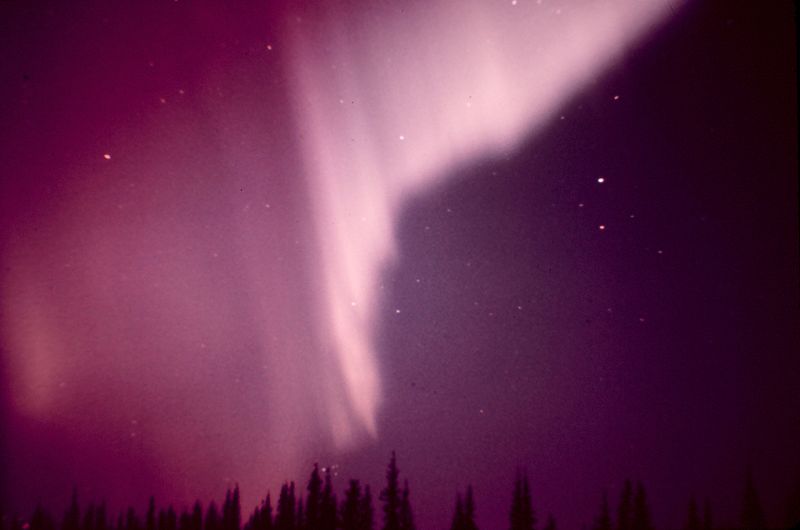
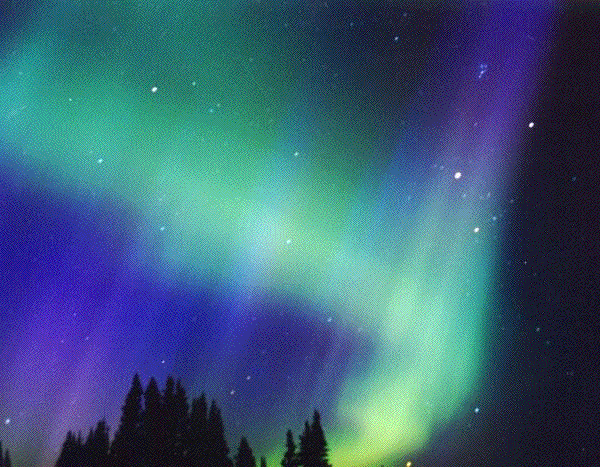
One of the most beautiful things to be seen in the world are the northern and southern lights (aurora borealis and aurora australis respectively). For those of us who have yet to see them in person, I believe we are missing out on something special and spectacular. One only needs to do a google search to see ample evidence of their beauty.


I dream of one day being able to see such beauty for myself. To sit in awe beneath the shimmering lights I feel would be utterly breathtaking.

Part of their beauty and magnificence is the mystery involved; that is until now.

Science as always wishes to know more and more about our world and that is not a bad thing. For the past couple of years scientists in both Canada and the US have worked to better understand the cause of these magnificent lights, and apparently they have found the cause.

"The Earth's magnetic field buffers the planet from much of the cosmic radiation of the solar wind, but in doing so takes on the shape of a teardrop, with the side facing the sun compressed while the opposite side stretches out into a far-reaching tail.

One theory on solar substorms suggests that as energy builds up in this tail it stretches it out farther and farther out until, stretched to its limit, the magnetic field snaps back like an elastic band, converting the built-up energy into kinetic and heat energy that returns to the Earth.

Some of the charged particles hit close to the planet's upper atmosphere, where they interact with the gas molecules to create the spectacular displays that are viewable at high latitudes."

Interesting, no doubt, however I can't help but echo the insightful comment of one of my favorite people; Calvin.


Yes, that Calvin.

It was Calvin (speaking for the masterful Bill Waterson)that said:

"That's the problem with science. You've got a bunch of empiricists trying to describe things of unimaginable wonder."

I would have never thought it possible for someone to make these magnificent displays seem so boring. Charged particles interacting with gas molecules. Whoopee.

As important as scienitic inquiry and discovery is, perhaps they could hire a few writers to come up with descriptions that match the beauty and wonder of what they are describing.

Tuesday, July 15, 2008

- shakes head -

I'm proud to be Canadian. I thank God that I was born in such a place as Canada. Sometimes though there are things that happen in Canada that really makes me wonder what the hell is going on in my country.

Two such cases have turned up over the past two days.

The first is a case where an ex-serviceman, a person who was willing to lay his life on the line in defence of this nation, is looking at being evicted from his apartment for flying the Canadian flag.

What?!

Apparently the powers-that-be that control his rental unit feel that this gentleman is violating the rules because "he was told the flag violates a rule requiring all subsidized properties to have a uniform appearance."

What has Canada come to when it's against the law to fly the Canadian flag?

It is my sincere hope that his neighbors would take up the challenge, come to the defence of their neighbor and sanity by flying flags as well. Then the units would have a uniform appearance.

****

The second is a case where a mother has had her children removed from her custody by the state due to her political beliefs. The mother in question is a proponent of 'white pride' and when her daughter had had the swastika that she had drawn on her arm removed by her teacher, the mother helped her daughter redraw the swastika.

Now in no way am I defending racism or supporting 'white power' mongers but I have to wonder what Canada has come to when what a parent believes is justification for losing custody of their children.

"University of Winnipeg professor Helmut-Harry Loewen, an expert on hate groups, said while he disagrees with the ideology, he fears taking custody based on beliefs is draconian.

"If children are apprehended based on parents' political or religious beliefs, then one is opening a kind of slippery slope," he said."

Who is to decide who's beliefs are right?

I'm reminded of a quote from George Orwell's classic Nineteen Eighty-Four:

"Power is not a means, it is an end."

This smacks of Orwellian thought police when the state can come in and dictate what right and wrong belief are. Especially when they have the power to deprive one of their very children if they are found to be in violation of the state's dictates.

Today it concerns racism and the promotion of white supremecy, something that is understandable. What will it concern tomorrow?

It's a sad day in Canada, in my opinion, when not only can the state do such a totalitarian thing but have it be supported:

"University of Manitoba professor Harvy Frankel, dean of the faculty of social work, said officials did the right thing.

"We should be reassured that this is child welfare practice as it should be."

Wednesday, July 02, 2008

Where the path leads

Last Friday my plans for Korea became much clearer. I was able to meet with two of my future Korean supervisors who had traveled to Canada from Korea. The meeting was informal, over coffee at a hotel restaurant, but I was a bit nervous nonetheless. The questions they asked were about what I had expected and addressed my reasons for wanting to teach in Korea, classroom management techniques, whether or not I'm a team player, and how I anticipate handling the culture shock. Everything went fairly well and I was officially offered the job and proceeded to sign my name about a hundred times.

During this time I was also able to talk about where it is that I would be teaching. The location was dictated by which age range I was interested in teaching. I decided to go with my training and stick with the elementary grades. This provided me with a few options, all of which were in smaller cities in south-eastern Jeollanam-do.

Map of Korea showing the Jeollanam-do prvince

I don't remember all of the names but the one I went with was the largest of the cities offered: Suncheon.

Map of Jeollanam-do province showing the Suncheon area

I chose Suncheon for a couple of different reasons. Firstly was its size. While small by Korean standards at approximately 270,000 people, it will be by far the largest place I have ever lived. It's my hope that this size will allow for something of a western presence in the city to help with some of the culture shock and with acquiring the amenities that I am accustomed to, but also it's small enough that I can experience much of Korean culture.

Second was its location at the intersection of two rail lines; the Gyeongjeon Line (running east - west) and the Jeolla Line (running north-south). I figure that this will allow for fairly easy travel around the country and connection to Korea's high speed rail lines.


Third was the living situation. The recruiter told me that most if not all of the western teachers that they had placed in Suncheon, approximately fifty in all, lived in the same apartment complex. This interested me as it offers me something of a ready made social community. This I feel will not only be important for helping with the culture shock and acclamating myself to Korea, but given the fact that I will be the only western teacher at my school I can't rely on meeting other westerners at my job like many english teachers.

The Jeollanam-do coast line

Jeollanam-do is known more for its agricultural production than anything else. It isn't as mountainous as other sections of Korea which allows for greater farming. Jeollanam-do also has nearly 6,100 km's of coastline and approximately 2000 islands. The province receives abundant rainfall and has the warmest weather in Korea.

Suncheon, known as the City of Beautiful People, is a mixed agricultural industrial city located near Suncheon Bay. Situated a little over an hour from the provinces largest city, Gwangju, and roughly forty minutes north of the port city of Yeosu, Suncheon is experiencing strong development.


Cultural and historical attractions near Suncheon include the 16th century Suncheon Japanese Castle, Baekje stone castle, Naganeupseong Folk Village, the Songgwangsa Buddhist temple, and a UNESCO World Heritage Site featuring grave markers, Dolmen, from the first century BC.

It looks like it will be an interesting place to live and explore.